SI Joint
The SI Joint, Hypermobility, and the Core - Why Stability Starts From the Inside Out
If you've ever felt a deep, one-sided ache low in your back, near where your spine meets your pelvis, there's a good chance you've met your sacroiliac (SI) joint. For most people this joint is a quiet, hardworking structure that barely gets a second thought. But for people with hypermobility, the SI joint can become a recurring source of pain, instability, and frustration: the sense that your pelvis is "slipping" or "out of place."
Understanding why this happens, and how the deep core and breathing pattern factor into the solution, can change how you approach training, rehab, yoga, and daily movement.
What the SI Joint Actually Does
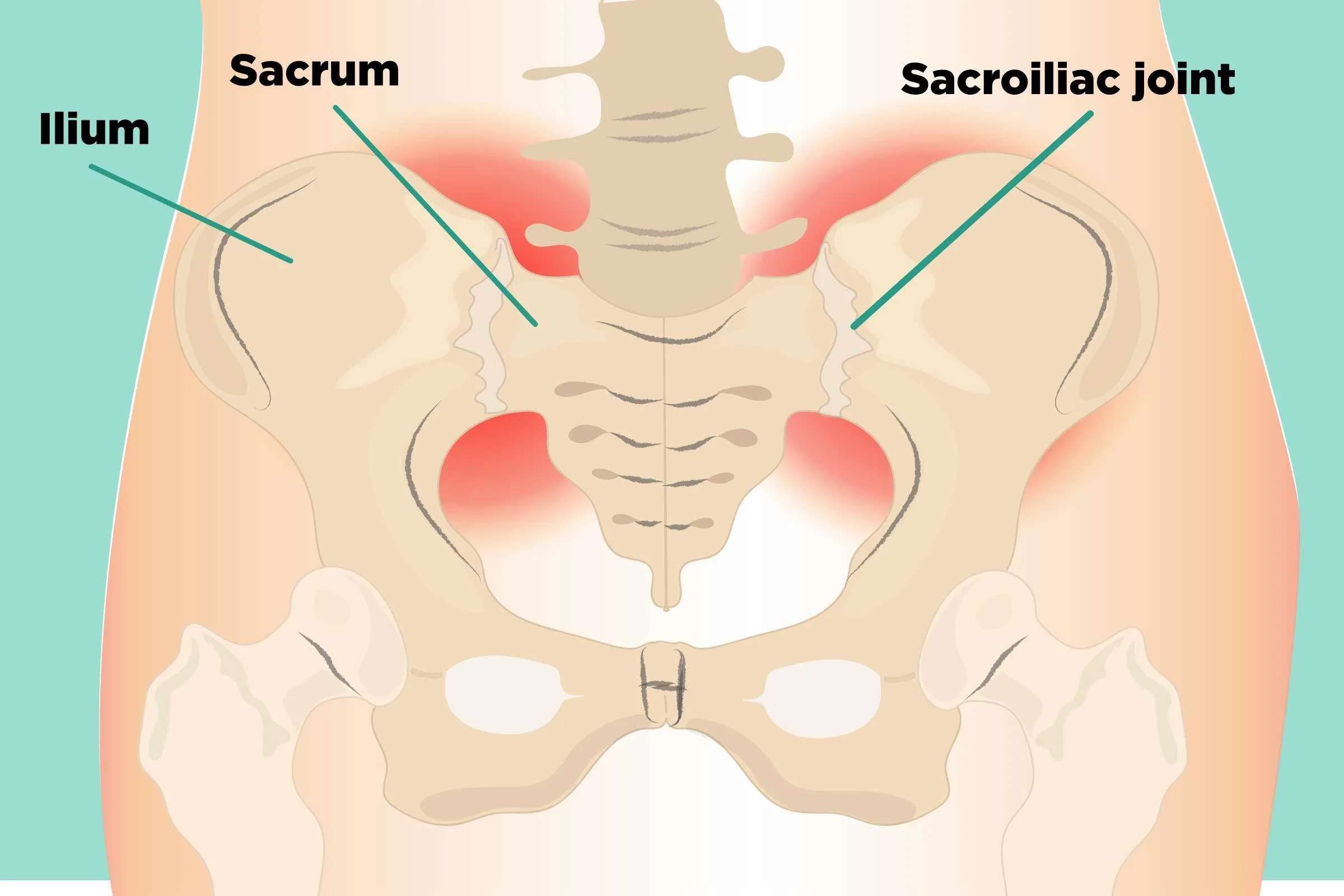
The sacroiliac joints sit on either side of the sacrum, connecting it to the two halves of the pelvis (the ilia). Unlike a hinge joint such as the knee, the SI joint is designed for very small amounts of movement, typically only a couple of degrees of rotation and a few millimeters of gliding. Its job isn't mobility; it's load transfer. Every time you walk, run, stand up, or shift your weight, forces travel from your legs through the pelvis and into the spine, and the SI joint is the checkpoint where that transfer happens.
Because so much force passes through such a small joint, stability here matters enormously. The body relies on two systems to keep it stable:
Form closure: the passive fit of the joint surfaces and the strength of the surrounding ligaments, which lock the joint into place almost like a keystone in an arch. The main ligaments involved are the posterior and anterior sacroiliac ligaments, the interosseous sacroiliac ligament, and the sacrotuberous and sacrospinous ligaments, which resist excess rotation of the sacrum.
Force closure: the active compression created by muscles contracting around the joint, adding stability on top of the passive structure. Key contributors include the gluteus maximus, piriformis, deep abdominal and back muscles, and the hamstrings.
In a well-functioning system, form and force closure work together so the SI joint barely moves at all, no matter how much force is loaded through it.
Where Hypermobility Changes the Picture
Hypermobility, whether it's generalized joint laxity, a hypermobility spectrum disorder, or connective tissue conditions like Ehlers-Danlos syndrome, means the ligaments and connective tissue around joints are more elastic than average. That's a double-edged sword. Extra range of motion can be an asset in dance, gymnastics, or swimming, but it also means the passive "form closure" system around the SI joint is less reliable. The ligaments that are supposed to lock the joint in place simply stretch more than they should.
This is often described as the SI joint "slipping" or moving out of alignment. In most cases, the joint isn't actually dislocating. But because the ligaments allow more micro-movement than the joint is designed for, the surrounding muscles, nerves, and tissues can become irritated, inflamed, or fatigued from constantly trying to compensate. The result is pain, a feeling of instability, clicking or shifting sensations, and sometimes pain that seems to move between the low back, hip, and buttock.
Pregnancy is a well-known example of temporary hypermobility: the hormone relaxin loosens pelvic ligaments to prepare for childbirth, and SI joint pain is extremely common as a result. People with hypermobile joint profiles experience a similar vulnerability all the time, not just during pregnancy.
SI Joint Stability Matters, Even Without Hypermobility
It's worth pausing on this: SI joint stability isn't only a hypermobility issue. Even in someone with completely typical ligament tension, the SI joint can become painful or dysfunctional through other pathways, including prolonged sitting, repetitive one-sided loading (always carrying a bag on the same shoulder, favoring one leg, running on cambered roads), pregnancy and postpartum recovery, a fall or direct impact, or simply weak or imbalanced glute and core muscles that don't provide enough force closure. Because the ligaments of a typical SI joint are already working near capacity to hold the joint together under everyday load, any added demand, whether from a weak core, a poor movement pattern, or a single awkward twist, can be enough to irritate it. This is why the same deep-core and breath-based stability strategies described below are broadly useful. A joint built to move only a couple of degrees needs consistent muscular support to stay pain free, regardless of how naturally flexible or stiff someone's connective tissue is.
Why the Deep Core Becomes the Real Stabilizer
When form closure is compromised by lax ligaments, the body has to lean more heavily on force closure, meaning active muscular support, to keep the SI joint stable. This is where the deep core comes in.
The "deep core" isn't the six-pack muscles most people picture. It refers to a group of muscles that work together almost like a pressurized canister around the trunk and pelvis:
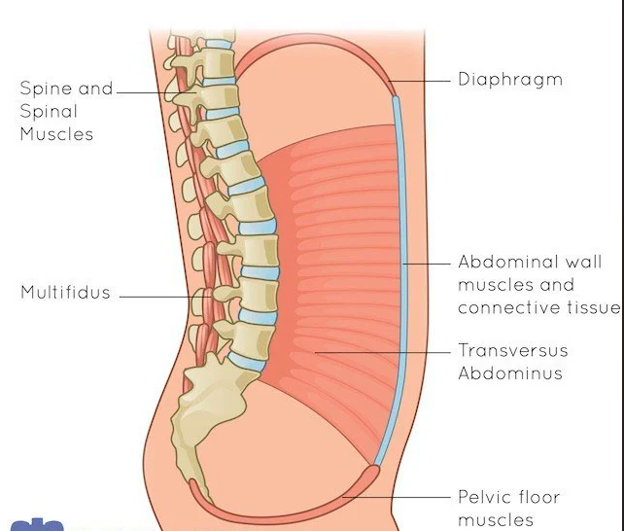
Transverse abdominis: the deepest abdominal muscle, wrapping around the trunk like a corset and compressing the abdominal contents.
Multifidus: small muscles running along the spine that stabilize each vertebral segment.
Pelvic floor: the muscular base of the pelvis, which supports the pelvic organs and contributes to pelvic stability.
Diaphragm: the dome-shaped muscle that separates the chest from the abdomen and forms the "roof" of this canister.
When these four work together, they generate what's often called intra-abdominal pressure (IAP), a controlled increase in pressure inside the trunk that stiffens the torso and pelvis from the inside, much like inflating a tire adds rigidity to the whole wheel. This internal pressure directly increases force closure around the SI joint, compensating for the extra "give" in stretchy ligaments.
For someone with hypermobility, training this system isn't optional extra credit. It's often the single most useful thing they can do to reduce SI joint symptoms. Strengthening superficial muscles, like the glutes or obliques, still matters, but without a well-functioning deep core, those muscles are working on top of an unstable foundation.
Why Diaphragmatic Breathing Is the Missing Link
This is where breathing pattern becomes surprisingly central to SI joint health. The diaphragm is a core muscle, not just a breathing muscle, and how you breathe directly affects how well the rest of the canister can do its job.
Many people, especially under stress or after developing pain, shift into shallow "chest breathing," using the neck and upper chest muscles to breathe rather than the diaphragm. This pattern has a few consequences:
The diaphragm stops doing its stabilizing job. If it isn't descending properly with each breath, it can't help generate the intra-abdominal pressure that supports the pelvis and spine.
The pelvic floor and diaphragm lose their coordination. These two muscles are meant to move together: the diaphragm descends as the pelvic floor lengthens on an inhale, and both rise back up on an exhale. When breathing is shallow, this piston-like relationship breaks down, weakening the whole canister.
Compensation patterns increase. Without a functioning deep core, the body recruits larger, more superficial muscles, like the lower back extensors or hip flexors, to create stability, which can increase tension and pain around an already irritated SI joint.
Diaphragmatic (or "belly") breathing retrains this system. By practicing slow breaths that expand the belly and lower ribs 360 degrees, not just the chest, you re-establish the diaphragm's role as a stabilizer, restore its coordination with the pelvic floor, and improve the body's ability to generate appropriate intra-abdominal pressure during movement. This is often the starting point in rehab programs for SI joint dysfunction, well before any loaded core exercises are introduced, because a strong "core" built on a dysfunctional breathing pattern tends to be inefficient and, at times, counterproductive.
Yoga Poses That Can Add Stress to the SI Joint
Yoga is often recommended for SI joint health, but not all poses are equally SI-friendly. Deep, asymmetrical hip openers and unsupported forward folds are the most common culprits, especially for hypermobile practitioners who can move past the point their ligaments can safely control.
Pigeon Pose (Eka Pada Rajakapotasana) and King Pigeon. This pose relies on deep external rotation of the hip. That range of motion can transmit directly into the SI joint, and in hypermobile hips the joint often moves before the end of the intended stretch is even felt.
Cow Face Pose (Gomukhasana). Stacking the knees asymmetrically rotates one side of the pelvis relative to the other, loading one SI joint more than the other.
Bound Angle / Butterfly Pose (Baddha Konasana), especially with the torso folded forward. The wide external hip rotation in this pose can pull unevenly on the pelvis if one hip is looser than the other.
Warrior I (Virabhadrasana I). Squaring the hips while the back foot stays turned out creates a rotational, shearing demand on the pelvis, particularly when the front knee tracks past the ankle.
Unsupported forward folds, standing or seated, with straight legs. Straight-leg forward folds pull the hamstrings and pelvis one way while the weight of the upper body pulls the opposite way, creating a shearing force directly across the SI joint.
Deep, unsupported twists. Rotating the spine while the pelvis is not squarely grounded can translate torque into the SI joint rather than the intended spinal segments.
None of this means these poses are off-limits forever. It means they deserve modification, such as bending the knees, using a block, or reducing range, especially for anyone with a known hypermobile or unstable SI joint.
Yoga Poses That Support a Healthy, Stable SI Joint
The most SI-friendly yoga poses share a common thread: they build symmetrical strength in the glutes, core, and back rather than chasing end-range flexibility. Many also reinforce the breath-to-core connection described above.
Bridge Pose (Setu Bandhasana), feet and knees hip-width, optionally with a block between the knees. Bridge strengthens the glutes and hamstrings symmetrically, which supports the pelvis evenly from below and is considered one of the more reliable SI-stabilizing postures.
Bird Dog (from hands and knees). Extending opposite arm and leg while keeping the hips level trains the deep core and back muscles to keep the pelvis stable during movement, which mirrors how the SI joint needs to behave in daily life.
Modified Triangle Pose, with the front knee softly bent or a block under the hand. Bending the front knee reduces the shearing pull on the SI joint while still allowing a side stretch, and it lets the legs and core engage for support rather than relying on ligaments at end range.
Sphinx and Locust Pose (gentle backbends). These build strength in the back extensors and glutes without pushing the hips into extreme rotation, and can be paired with a gentle drawing-in of the belly on the exhale to cue deep core support.
Child's Pose (knees comfortably apart, hips supported). A gentle, symmetrical resting pose that relieves pressure on the lower back and SI joint without stretching it toward an end range.
Pelvic tilts and supported bridge holds. Small, controlled movements of the pelvis build awareness and strength in the deep core and glutes, which is often the starting point in rehab programs before progressing to full poses.
Mountain Pose (Tadasana) with active hip engagement. Gently drawing the outer hips in toward the midline while standing activates the muscles that provide force closure, turning even a resting pose into light stability training.
A consistent theme across these poses is symmetry and support: using both sides of the body evenly, keeping the pelvis level, and engaging the core and legs rather than relaxing into a passive stretch.
Yoga During an SI Joint Flare
When the SI joint is actively flared, meaning noticeably painful, swollen-feeling, or unstable, the goal shifts from general stability training to calming things down. This calls for a more conservative list than day-to-day practice, and a few poses that are fine as general SI maintenance are worth skipping until the flare settles.
Poses to Avoid When Symptoms Are Flared
All the asymmetrical and end-range poses listed above. Pigeon, cow face, deep bound angle folds, Warrior I, unsupported forward folds, and deep twists all ask the SI joint to do more than it should during a flare, even in a mild or modified form.
Unsupported single-leg standing balance poses (Tree Pose, Half Moon, Warrior III). Bearing full weight on one leg shifts load unevenly through the pelvis, which can aggravate an already irritated joint.
Deep backbends (full Wheel, Camel, deep Cobra). These combine spinal extension with an anterior tilt of the pelvis, which can compress or gap an inflamed SI joint depending on which side is affected.
Wide-stance or long-lunge poses (Warrior II, wide-legged forward fold, Skandasana / deep side lunge). A wide, asymmetrical base places uneven rotational stress on the two sides of the pelvis.
Any pose that reproduces the familiar one-sided ache. If a pose recreates the specific pain, that's a direct signal to stop, regardless of whether it appears on a general "poses to avoid" list.
A Gentle Reset: Poses to Include, With Proper Core Engagement
The following sequence favors small, symmetrical, breath-led movements that cue the deep core (particularly the transverse abdominis and pelvic floor) without asking the SI joint to move.
Constructive rest with diaphragmatic breathing. Lie on your back with knees bent, feet flat and hip-width apart. Place a hand on your belly and breathe so the belly and lower ribs expand 360 degrees on the inhale. On the exhale, gently draw the low belly in and slightly flatten the low back, as if bracing for a light tap to the stomach. This re-establishes the diaphragm-pelvic floor connection before asking any muscle to do heavier work.
Pelvic tilts. From the same position, gently rock the pelvis to flatten the low back into the floor on an exhale, engaging the deep abdominals, then release to neutral on the inhale. Keep the movement small and pain free; this is about activation, not stretching.
Supported Bridge with a block between the knees. Feet and knees hip-width, block held gently between the knees to keep the pelvis symmetrical. Engage the low belly first, then press through both feet evenly to lift the hips a small amount, squeezing the glutes at the top. The block prevents the knees from splaying and keeps the load even across both SI joints.
Modified Dead Bug. Lying on your back with knees bent at 90 degrees over the hips, engage the low belly to press the low back gently into the floor, then slowly lower one heel toward the floor while keeping the pelvis completely still. Return and switch sides. This trains the core to stabilize the pelvis while the limbs move, which is exactly what the SI joint needs during daily activity.
Supported Child's Pose. Knees apart, hips sitting back onto a block or bolster for support, forehead resting down. A passive, symmetrical resting shape that takes weight off the SI joints without stretching them.
These resets are typically most useful in short, frequent doses (a few minutes at a time) rather than one long session, and they work best done slowly, with the breath leading each movement rather than the movement leading the breath.
This article is for general educational purposes and isn't a substitute for individualized medical advice. Anyone experiencing persistent SI joint pain or symptoms of hypermobility should consult a physical therapist or physician for an assessment tailored to their body, and should stop any yoga pose that causes sharp or one-sided pain.